Mostrando entradas con la etiqueta Mochaccino. Mostrar todas las entradas

miércoles, 23 de mayo de 2018

Debunking Myths Around Coffee


Coffee, as a part of humanity, has come along with a plethora of questions, and in early attempts to answer them, we came up with some misconception, in turn resulting in myths when history perpetuated them. Putting away substances like alcohol and even cannabis, coffee is one of the most controversial substances we consume.

Common Myths and Misconceptions about Coffee
To bring some light into the subject and debunk some coffee-related myths, That Coffee Roasters decided to list some of the most common misconceptions around the beverage and explain the truth behind them.

Myth number 1: “Don’t drink coffee in the afternoon, it’ll give you insomnia.”
Caffeine is a stimulant chemical, this is a fact. But the caffeine in an average cup of coffee is quickly processed through the body, and most of this substance (an estimated 75%) is disposed of by the body in the following five hours, far away from nighttime.

Myth number 2: “Coffee can dehydrate you.”
Coffee is mostly water with natural additives. All of the H2O in a cup makes up for the dehydrating natural effects of caffeine, that are not strong enough for dehydrating a person when it’s diluted in water. Still, it shouldn’t be your drink of choice after a big game.

Myth number 3: “Got hangover? Drink coffee.”
Sure, it can reduce the grogginess the morning after a big party, and make you more alert as coffee often does. But it can’t cure the hangover.

Myth number 4: “Coffee can make you lose weight.”
Coffee has the property of enhancing the metabolism speed, but not for much and not for long, thus making it effective for dieting. Caffeine may reduce your desire to eat for a brief time, nonetheless.

Myth number 5: “Be careful, caffeine is highly addictive.”
This is only a half-truth myth because there could be some risks but the addiction is not as depicted on tv and media, coffee is not a gateway drug. Nonetheless, it stimulates the Central Nervous System; but the symptoms and withdrawal are nothing compared to real drugs.

Myth number 6: “Coffee will stunt your growth.”
This myth has been around forever, and it’s often said to children. However, the belief that coffee does stunt your growth is a lie. No scientific evidence supports this one.

Myth number 7: “Coffee causes heart diseases, cancer, etc.”
Yet again, no scientific evidence supports this myth. However, we always recommend avoiding excesses, even in coffee. If you suffer from high blood pressure, you might experience a temporary, yet not excessive, rise in your heart rate, but there is no scientifically proven link between caffeine and high cholesterol nor cardiovascular diseases.

Myth number 8: “Coffee is bad for pregnant women and their babies.”
Caffeine won’t directly harm a fetus. However, it’s advised that women should limit their daily caffeine intake to about one cup of standard coffee each day. Caffeine can reach the baby via the placenta, but no concrete studies are proving this to be harmful.

Myth number 9: “All coffee has the same amount of caffeine.”
Not all brews are the same, and some cups have a lot more caffeine than others. Not all coffee is created, grown or prepared equal, and this can definitely explain why some shops make coffee that gives you a little more buzz than others.

Did you believe in any of these myths? Or were you surprised by the truth? Don’t forget to leave your comments and questions on the section below, and follow us on out That Coffee Roasters social networks.


Phone Number: (305) 821-8811

miércoles, 11 de abril de 2018

Coffee Definitions for Coffee Businesses

To be a coffee professional, you must know what an espresso is and what does "fair trade" means.

If you want to enter the world of coffee business, you must be familiar with all the terms and elements that help you to understand the processes and elaboration of your future product. In every industry, the fundamental requirement is to know the basics and understand the market, and for that, you need to learn the most important concepts. Taking all these aspects into account,
That Coffee Roasters offers you a set of coffee definitions that could help you plan your next steps into the coffee world.


That Coffee Roasters’ dictionary: Coffee Definitions
You may find that the coffee terminology is simple, you don’t need much knowledge to know the differences between types of preparations and coffee. However, this statement couldn’t be more mistaken. Coffee goes through so many processes, transformations, preparations and transactions that it’s difficult to identify and define each one of the related terms. That’s why That Coffee Roasters has put together a list of coffee definitions that will serve as a short introduction to the real coffee field.


Acidity: this term does not refer to the amount of acid or pH in coffee, but to the kind of fruity or wine-like taste that can be perceived in some Arabica coffees.


Aged coffee: this is not stale coffee, but green coffee kept in warehouses for an extended time period to change its taste, reduce its acidity and increase its body.


Air roaster: a machine that uses hot air streams to roast coffee beans. It’s a method in which the beans are in constant movement to ensure that they are roasted evenly.
Americano: it’s usually a mixture of one or two shots of espresso with a little hot water. Depending on the amount of water it can have a stronger or less strong taste.


Arabica: it’s one of the oldest and most cultivated species of coffee. It represents 70% of the produced coffee in the world. It’s grown at high altitudes and has a lower level of caffeine.


Blade grinder: a machine that uses spinning blades to crush coffee beans and turn them into ground coffee. The problem with this method is that the grinding is not consistent, there are particles of different sizes.


Blooming: this is the effect that occurs when freshly roasted and ground coffee comes into contact with hot water. Coffee puffs up like a mushroom because the roasted beans are not properly degassed.


Brewing: it’s the action of preparing coffee through any method that includes mixing hot water with ground coffee.


Burr grinder: it’s a coffee grinder that uses metal discs with sharp ridges to obtain a uniform grind. This tool can be adjusted to produce fine or coarse coffee particles.


Caffeine: Caffeine is an alkaloid found in coffee beans. It’s a stimulating substance that can keep you awake and alert. Today, you can find caffeine in beauty products and medical treatments.


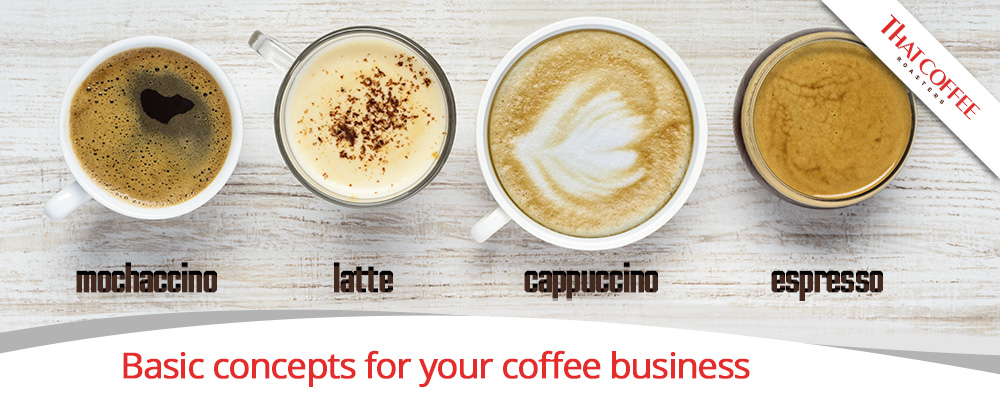
Cappuccino: this is one of the most famous coffee preparations. It usually contains 1/3 of espresso topped with 1/3 steamed milk and 1/3 milk foam.


Cherry: it’s the term given to the fruit of the coffee tree. When they are ripe and red, they are harvested, and the skin, pulp, and parchment are removed.


Coffee roasting: it’s the process by which green coffee is transformed into roasted coffee. The taste of these seeds changes and varies depending on the coffee roast, which can be light, medium, dark-medium or dark.
Coffeol: it’s the oil that can be seen when the coffee bean has been roasted. It mostly appears during the dark-medium or dark roasting.


Cupping: it’s a sensory evaluation of coffee performed by experts taking into consideration the aroma, acidity, taste, and body of the product. In general, hot water is poured over the ground coffee, and the resultant liquid is tested both cold and hot.


Degassing: it’s the process by which freshly roasted coffee beans are left to stand for a time so that the carbon dioxide produced during roasting can be released. Depending on the type of coffee, this process can take more or fewer days.


Dry-processed coffee: it’s the drying coffee method by which the husk and pulp of the coffee cherry are removed after it has been sundried.


Espresso: it’s a way of preparing coffee in which hot water is forced under pressure through finely ground coffee. The result is a strong, thick liquid.


Fairtrade: fairtrade is the purchase of coffee directly from farmers at a fair price. This method seeks to ensure that farmers receive a fair payment that will help them to continue the production and to improve their life quality.


Green coffee: this is the unroasted bean, which has gone through several processes before roasting, such as harvesting and drying.


Grind: it’s the action of reducing the roasted coffee bean to small particles or powder. There are several types of grind: fine, medium, and coarse.


Latte: it’s another of the most popular coffee preparations. Like the cappuccino, the latte contains a shot of espresso, steamed milk, and milk foam. However, in this case, the steamed milk ratio is higher.


Mochaccino: this is also a very popular way to drink coffee. The biggest difference between cappuccino and latte lies in the chocolate that’s added.
Pulping: it consists of removing the pulp from the fruit. It’s part of the wet method for processing and drying coffee.


Robusta: it’s one of the most widely used coffee species in the industry. It grows at low elevations and is very resistant to pests. The coffee bean of this tree is usually smaller and bitter.


Specialty coffee: it’s a concept that was born in 1974, and made reference to a specific profile of coffee with a unique flavor that came from microclimates. Currently, coffees that score 80 to 100 points are defined as specialty coffee.


Wet-processed coffee: it’s another type of coffee processing and drying method. In this case, the cherries are first immersed in water and then go through several processes before reaching the drying stage, which is carried out by exposing the coffee seed to the sun or drying it with a machine.


A lot of coffee definitions, don't you think? However, this is only a fraction of all terms related to the coffee industry. If you want to know more about coffee and its processes, and learn new coffee definitions, follow us through our social networks as That Coffee Roasters and become an expert in coffee roasting!


Learn the definitions that every owner of a coffee business should know.


Phone Number: (305) 821-8811
Instagram: thatcoffeeroasters

jueves, 9 de noviembre de 2017

Storytime!: Why So Many Coffee Drinks Have Italian Names?

You should thank Italians for your daily cup of coffee!


Let’s play a little game and tell us if we guess right: Most of your favorite coffee drinks have espresso as its base ingredient. You can’t start your mornings without your cup of cappuccino. Isn't it right? Well, maybe coffee latte is your thing? Or perhaps you have a sweet tooth and prefer a mochaccino? One thing is certain. If we were to guess only by their names, all coffees' names seem to have come from one single place: Italy.

At least that’s how it feels with the most popular coffee drinks. All the best-known coffee beverages sound very Italian. So what’s up with this? Did Italians discover our favorite drink? Well, we know that our love for caffeine originated in Africa, so that’s not it. Actually, coffee first arrived in Italy through trade between North Africa and Venice during the 16th century. But still, there’s a reason why Italy has become the coffee capital of the world, and we’re here to find it out!

Why Espresso Changed Everything?
The key to exploring why Italian coffee culture became so famous in the first place is to focus on its most replicated product: espresso. Although today you can spend minutes ordering your drink and adding many ingredients to it, the original purpose of espresso was to have the ability to serve a shot of coffee as quickly as possible. We’ve got to thank the Industrial Revolution for it because it brought us the machine that made it possible. The “machinetta” was created by Luigi Bezzara in 1901, and it was responsible for compressing coffee and forcing pressurized water through it.  

Ever since then, coffee's world changed. Coffee houses were no longer just tranquil places. They were filled with the buzz of workers and businesspeople who entered every morning looking for a shot of espresso to fuel their day. It became an icon of the new century, and it arrived at the perfect time to become popularized in the whole country and, subsequently, in the rest of the world.
Original espresso tasted very different from what you enjoy today. The first machines' precariousness gave this drink a bitter and burnt flavor, and it was actually more similar to regular filtered coffee than present-day espresso. But because of how fast they were served, they were successfully commercialized in what was known as American bars: coffee shops in which customers stood on one side of the bar while waiting for their order.

Espresso consumption continued to grow until Mussolini’s fascist regime. Coffee imports were banned, and by the time of the II World War, coffee had virtually disappeared from Italy. One curious fact is that the term ‘barista’ actually comes from fascist Italy, as a way to oppose the American word then used: ‘barman.'

Nevertheless, the Italian coffee industry didn’t forget about espresso's potential as a unique beverage, and inventors continued to improve coffee machines in an effort to erase coffee's burnt flavors and contamination. By the 1950’s, Italians had created a new way to make espresso called caffè crema, which presented its famous mousse on top of the beverage. One we still see in espressos today.

Caffè crema's arrival marked the start of Italian influence in coffee drinks as we know it nowadays. This new espresso spread all across Italy. Other countries started to replicate and import it as well, as many Italian emigrants influenced coffee culture everywhere they went.

Coffee’s Social Function
But then what about cappuccino, latte, mochaccino…? Why did we continue to call almost every coffee drink by their Italian names? Italians didn’t invent the combination of coffee and milk. That already existed in Europe since the 17th century. Well, it’s solely because Italians were responsible for switching from regular filtered coffee to espresso. Cappuccino's original name comes from the Viennese version called kapuziner, inspired by Capuchin monks who lived in Vienna. It wasn’t until 1930 that Italians started to make their own version with espresso as the main ingredient.

Cappuccino and other types of coffee drinks became popularized because they served a bigger purpose than regular espresso. The whole process of adding frothing milk to a cup of coffee started to become a part of coffee houses' experience, in sound, image, and taste. It also added an extra to cafes' social function. Coffee bars were perfect for meeting people, friends, and coworkers, so it was necessary a drink that took longer to consume.

Nowadays, Italians are still very protective of their coffee culture. Even though in America we are used to adding tons of ingredients to coffee and tasting different combinations, more traditional Italians prefer their espresso as classic as they can get. Globalisation is changing this though. American coffee methods are making their way through Italian coffee houses, even though they’re still sticking to their original ways. The good news is that we can experience the best of both worlds and celebrate our love for coffee.

Even though we have a lot to thank Italians, the truth is that Mediterranean climate is not very good for coffee production. To get the best coffee beans, you can count on Latin Americans to save your day! At That Coffee Roasters, we believe that nothing beats true Colombian coffee when it comes to brewing your favorite Italian drinks, so kudos to cultural exchange!


Which one is your favorite Italian coffee?


Phone Number: (305) 821-8811


How are Raw Coffee Beans Treated?

Treatment for your beans Raw coffee beans are not coffee-worthy. Ok, let’s rephrase that: with raw coffee beans, there’s not much you c...