Mostrando entradas con la etiqueta Espresso. Mostrar todas las entradas

miércoles, 2 de mayo de 2018

The Origins and History of Espresso

Who doesn't love a hot espresso?
Espresso machines have been around for a long time, but how did they were invented?


The espresso: the base drink of every non-filter coffee. The purest state of the beverage, and the key to understanding Italy’s (and most Europe’s) coffee culture. By giving us the espresso shot, Italy is the progenitor of both the second and third wave. This beautiful country redefined what coffee means.

Yet drinking coffee in Italy differs from doing so in the rest of the world: specialty coffee has struggled to take hold and big chain cafés have failed to gain a foothold. And to understand the reasons behind this, we need to look at how the modern espresso came into being and how that reshaped Italy’s culture and identity.

That Coffee Roasters Presents: An Espresso History


Back in the 19th century, coffee was a major flourishing business in Europe with cafes sprouting across the continent. But coffee brewing was a slow process around that time and, as is still the case today, customers often had to wait for their orders. Seeing this necessity as an opportunity, inventors all over Europe began to explore ways of using steam machines to reduce brewing time, this was, after all, the age of steam.

Though there were surely countless patents and prototype gadgets, the invention of the machine and the method that would lead to espresso is usually attributed to Angelo Moriondo (Turin, Italy), who was granted a patent in 1884 for “new steam machinery for the economic and instantaneous confection of coffee beverage”. This machine consisted of a large boiler, heated to 1.5 bars of pressure, that pushed the water through a wide bed of coffee grounds on demand, with a second, smaller boiler producing steam that would flash the bed of coffee and complete the brew. Though Moriondo’s invention was the first coffee machine that used both water and steam, it was purely a prototype brewer created for the Turin General Exposition.

Not much more is known about Moriondo, there aren’t even photographs of his work. With the exception of this patent, Moriondo has been almost lost to history. The two men who would improve on Morinodo’s design to produce a single serving espresso would take a different approach.

Luigi Bezzerra and Desiderio Pavoni (also Italians) were the real inventors of espresso. Milanese manufacturer and a “maker of liquors” of sorts, Luigi Bezzera had the intel in this matter. He invented single-shot espresso in the early years of the 20th century while researching for a method of quickly brewing coffee directly into the cup. He made several improvements to Moriondo’s prototype, introduced the portafilter, as many other innovations still associated with espresso machines today.

On the other hand, Bezzera’s original patent, also compound of a big boiler with a built-in burner chamber filled with water was heated until it pushed water and steam through a tamped batch of ground coffee. For the first time, a cup of coffee was brewed to order in a matter of seconds. But Bezzera’s machine was heated over an open flame, which made it more difficult to control pressure and temperature that it is nowadays, and almost impossible to produce a consistent brew. Looking for funds to further develop his inventions, Bezzera turned to his friend Desiderio Pavoni.

Pavoni bought Bezerra’s patents in 1903 and improved many aspects of the design. As of his first improvement, he invented the first pressure release valve. Pavoni also created the steam wand to access the built-up steam that collected inside the machine’s boiler. Bezzera and Pavoni then worked together to perfect their machine, which Pavoni dubbed “The Ideale”.

At the 1906 Milan Fair, the two inventors introduced the world to “Cafeé Espresso”. Bezzera, despite he may have even built Pavoni’s first machines, lost the spotlight as Pavoni continued to familiarize Italy with his new brand “espresso”. After the Milan Fair, similar espresso machines began to appear throughout the country, and Bezzera’s early prototype machine evolved into the elaborately gilded titans that look almost otherworldly.
These machines could produce up to 1000 cups of coffee per hour, but relied on steam and steam alone, which had the unfortunate side effect of imbuing the coffee with a burnt or bitter taste and could only accumulate, two bars of atmospheric pressure at some cases, far from what is to be considered espresso by today’s standard.

As electricity started to replace gas and Art Deco was the chicest thing, substituting the chrome-and-brass aesthetic of the early 20th century, the espresso machines became smaller and more efficient, but no coffee innovators managed to create a machine that could brew with more than 1.5-2 bars of pressure without burning the precious brew.

Among Pavoni’s growing competition was Pier Teresio Arduino. Arduino was an inventor determined to find a method of making espresso that didn’t depend exclusively on steam. Even though he thought of incorporating screw pistons and air pumps into the machines, he was never capable to implement his ideas to the extent he intended.

Arduino was a pretty good businessman and marketer, more so than Pavoni himself. He built a marketing machine around espresso, which included directing graphic designer Leonetto Cappiello to create the famous espresso poster that captured the very essence of espresso and the speed of the belle epoque. In the 1920s, Arduino had a much larger coffee shop than Pavoni’s in Milan and, as a result of his production capabilities and marketing wisdom, was largely responsible for exporting machines out of Milan and spreading the espresso across the rest of Europe. Meanwhile, the man that resolved the two-bar brewing issue was Milanese café owner Achille Gaggia.

Gaggia introduced the lever-driven machine. In Gaggia’s machine, invented after World War II, steam pressure in the boiler forces the water into a special cylinder where it’s further pressurized by a spring-piston lever operated by the barista.

Not only did this obviate the need for massive boilers, but it also increased the water pressure from 1.5-2 bars to 8-10 bars, a major advance on this matter. The lever machines also standardized the size of the espresso. The cylinder on lever groups could only carry an ounce of water, limiting the volume that could be used to make an espresso. With the lever machines, also came some new vocabulary: baristas operating Gaggia’s spring-loaded levers coined the term “pulling a shot” of espresso.

But perhaps the game changer was that with the invention of the high-pressure lever machine came the discovery of crema, that is the foam floating over the coffee liquid that is the defining characteristic of a quality espresso. A historical anecdote claims that early consumers were dubious of what they called “scum” floating over their coffee until Gaggia began referring to it as “cafe creme”, suggesting that the coffee was of such quality that it produced its own creme, thus making it even more original and exclusive. With high pressure and its golden crema, Gaggia’s lever machine marks the birth of the contemporary espresso.

The rest is history. Brought up for you directly from That Coffee Roasters, all questions are important in our community, and we are glad to answer all of them, so don’t be shy and leave them in the comment section as well as don’t forget to follow us on our social networks.


Where was the first espresso ever served?
An espresso has crema, a body, and a heart!


Phone Number: (305) 821-8811


miércoles, 11 de abril de 2018

Coffee Definitions for Coffee Businesses

To be a coffee professional, you must know what an espresso is and what does "fair trade" means.

If you want to enter the world of coffee business, you must be familiar with all the terms and elements that help you to understand the processes and elaboration of your future product. In every industry, the fundamental requirement is to know the basics and understand the market, and for that, you need to learn the most important concepts. Taking all these aspects into account,
That Coffee Roasters offers you a set of coffee definitions that could help you plan your next steps into the coffee world.


That Coffee Roasters’ dictionary: Coffee Definitions
You may find that the coffee terminology is simple, you don’t need much knowledge to know the differences between types of preparations and coffee. However, this statement couldn’t be more mistaken. Coffee goes through so many processes, transformations, preparations and transactions that it’s difficult to identify and define each one of the related terms. That’s why That Coffee Roasters has put together a list of coffee definitions that will serve as a short introduction to the real coffee field.


Acidity: this term does not refer to the amount of acid or pH in coffee, but to the kind of fruity or wine-like taste that can be perceived in some Arabica coffees.


Aged coffee: this is not stale coffee, but green coffee kept in warehouses for an extended time period to change its taste, reduce its acidity and increase its body.


Air roaster: a machine that uses hot air streams to roast coffee beans. It’s a method in which the beans are in constant movement to ensure that they are roasted evenly.
Americano: it’s usually a mixture of one or two shots of espresso with a little hot water. Depending on the amount of water it can have a stronger or less strong taste.


Arabica: it’s one of the oldest and most cultivated species of coffee. It represents 70% of the produced coffee in the world. It’s grown at high altitudes and has a lower level of caffeine.


Blade grinder: a machine that uses spinning blades to crush coffee beans and turn them into ground coffee. The problem with this method is that the grinding is not consistent, there are particles of different sizes.


Blooming: this is the effect that occurs when freshly roasted and ground coffee comes into contact with hot water. Coffee puffs up like a mushroom because the roasted beans are not properly degassed.


Brewing: it’s the action of preparing coffee through any method that includes mixing hot water with ground coffee.


Burr grinder: it’s a coffee grinder that uses metal discs with sharp ridges to obtain a uniform grind. This tool can be adjusted to produce fine or coarse coffee particles.


Caffeine: Caffeine is an alkaloid found in coffee beans. It’s a stimulating substance that can keep you awake and alert. Today, you can find caffeine in beauty products and medical treatments.


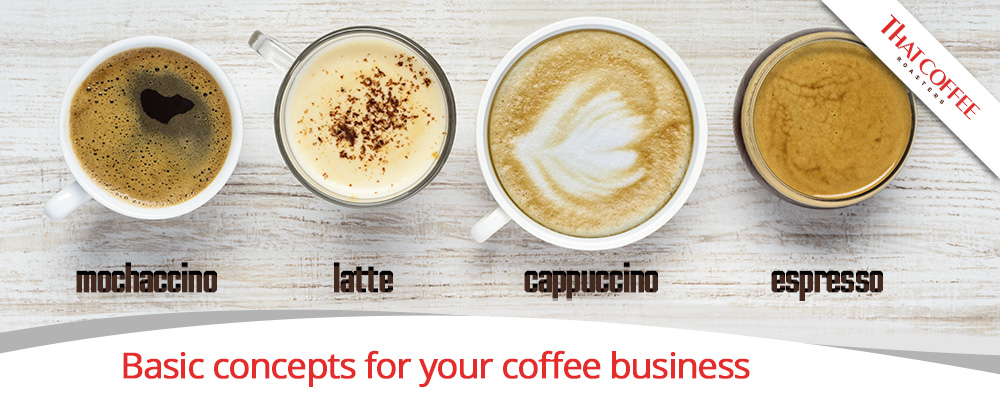
Cappuccino: this is one of the most famous coffee preparations. It usually contains 1/3 of espresso topped with 1/3 steamed milk and 1/3 milk foam.


Cherry: it’s the term given to the fruit of the coffee tree. When they are ripe and red, they are harvested, and the skin, pulp, and parchment are removed.


Coffee roasting: it’s the process by which green coffee is transformed into roasted coffee. The taste of these seeds changes and varies depending on the coffee roast, which can be light, medium, dark-medium or dark.
Coffeol: it’s the oil that can be seen when the coffee bean has been roasted. It mostly appears during the dark-medium or dark roasting.


Cupping: it’s a sensory evaluation of coffee performed by experts taking into consideration the aroma, acidity, taste, and body of the product. In general, hot water is poured over the ground coffee, and the resultant liquid is tested both cold and hot.


Degassing: it’s the process by which freshly roasted coffee beans are left to stand for a time so that the carbon dioxide produced during roasting can be released. Depending on the type of coffee, this process can take more or fewer days.


Dry-processed coffee: it’s the drying coffee method by which the husk and pulp of the coffee cherry are removed after it has been sundried.


Espresso: it’s a way of preparing coffee in which hot water is forced under pressure through finely ground coffee. The result is a strong, thick liquid.


Fairtrade: fairtrade is the purchase of coffee directly from farmers at a fair price. This method seeks to ensure that farmers receive a fair payment that will help them to continue the production and to improve their life quality.


Green coffee: this is the unroasted bean, which has gone through several processes before roasting, such as harvesting and drying.


Grind: it’s the action of reducing the roasted coffee bean to small particles or powder. There are several types of grind: fine, medium, and coarse.


Latte: it’s another of the most popular coffee preparations. Like the cappuccino, the latte contains a shot of espresso, steamed milk, and milk foam. However, in this case, the steamed milk ratio is higher.


Mochaccino: this is also a very popular way to drink coffee. The biggest difference between cappuccino and latte lies in the chocolate that’s added.
Pulping: it consists of removing the pulp from the fruit. It’s part of the wet method for processing and drying coffee.


Robusta: it’s one of the most widely used coffee species in the industry. It grows at low elevations and is very resistant to pests. The coffee bean of this tree is usually smaller and bitter.


Specialty coffee: it’s a concept that was born in 1974, and made reference to a specific profile of coffee with a unique flavor that came from microclimates. Currently, coffees that score 80 to 100 points are defined as specialty coffee.


Wet-processed coffee: it’s another type of coffee processing and drying method. In this case, the cherries are first immersed in water and then go through several processes before reaching the drying stage, which is carried out by exposing the coffee seed to the sun or drying it with a machine.


A lot of coffee definitions, don't you think? However, this is only a fraction of all terms related to the coffee industry. If you want to know more about coffee and its processes, and learn new coffee definitions, follow us through our social networks as That Coffee Roasters and become an expert in coffee roasting!


Learn the definitions that every owner of a coffee business should know.


Phone Number: (305) 821-8811
Instagram: thatcoffeeroasters

jueves, 5 de abril de 2018

Get to Know the Types of Coffee Roasts

Types of coffee roasts
The flavor, aroma, and color of the coffee will vary depending on the type of roasting. 

Did you know there are several factors that can determine the taste and aroma of your favorite coffee? One of the most important is roasting, an art that experts may take years to perfect, but once mastered, it provides several specific flavors and qualities to your favorite drink. These characteristics will depend on the type of coffee roast and the technique of the master roaster. But how complicated can it be to roast a coffee and select a color? In fact, it’s more complicated than it seems, because each type of coffee has a specific taste, aroma, acidity, and bitterness that is given at this stage of coffee production.

Knowing the types of coffee roasts

The difference between a good roast and a ruined product is time. During this process, every minute and second counts. It’s always necessary to consider that, depending on the method used by a roaster, the changes in color and stages may take more or less time.

Once you understand these factors that influence the quality of roasting, you should also keep in mind that the coffee industry doesn’t have standardized names and phase descriptions. Each company can have its own classification, although a simple measure that is often used, is one that defines four states: light roast, medium roast, medium-dark roast, and dark roast. Within these categories, small subdivisions with small variations in color and taste can also be found.

Light Roast

This type of roasting is characterized by colors ranging from pale orange to light brown. In general, the beans that are still in this stage have a grainy flavor and retain a higher percentage of acidity, caffeine and origin flavors. In the darker roasts of this stage, the “first crack” is usually heard. From this moment on, the coffee is more suitable for consumption.

Usually, the light roast category includes light City, Half City, and Cinnamon Roasts, in which the bean is roasted until before the first crack. Also in the category is the so-called New England Roast, in which the bean is roasted until the first crack.

Medium Roast

The colors in this category are mostly light and medium brown. As with light roast, the coffee beans don’t have any oil on the surface; however, their taste is more roasted and less grainy, and they have less acidity. Also, their caffeine level has decreased slightly, flavors are more balanced and have more body.

As part of this stage, some experts usually mention the City and Breakfast Roast, and the American Roast, a very common roast throughout the United States.

Medium Dark Roast

This type of roasting has a darker color and provides a bitterer flavor to the bean. At this stage, oils begin to appear on the surface of the seeds. The coffee that this type of roasting provides has more body than it’s given by the light and medium roast.

In this category, there are the so-called Full City and Vienna Roasts, characterized for being roasted until hearing the second crack.

Dark Roast

In this category, the color of the roast is dark brown and almost black. On the surface of the coffee bean, you can see the oils. The bitter and smoky taste predominates over the original flavors, and the levels of caffeine and acidity are lower than those of the other roasts.

This state includes the so-called High, Continental, French, New Orleans, European and Espresso Roasts. A wide variety of names and roasts, don’t you think?

With this introduction to the world of roasting, you’ll be able to identify more clearly which product might be the best for you or your customers. Remember that if you want to open a business in which main product is coffee, you must know how to identify the needs and tastes of your clients in order to offer them the right type of coffee roast.

If you want to know the variety of products that the different roasts can produce, look for us on our social networks as That Coffee Roasters and discover much more about your favorite coffee!

Types of coffee roasts
If you want to get into the coffee business, you must know the best roast!


Phone Number: (305) 821-8811

Instagram: thatcoffeeroasters

martes, 30 de enero de 2018

Alan Adler: The Inventor of the AeroPress Coffee Machine

How do these coffee machines work?


If you’ve ever looked for the best coffee makers to have in your home so you can brew the daily cup of joe that wakes you up every morning, chances are you’ve heard of the AeroPress, or you might have one in your kitchen. But what’s an AeroPress in any case? It’s a device for brewing coffee that was invented back in 2005 by an engineer called Alan Adler. In these coffee machines, the coffee is steeped for 10–50 seconds and then forced through a filter by pressing the plunger through the tube. The final result is a delicious espresso-like coffee thanks to which the AeroPress has become one of the favorite brewers among coffee lovers.


And it’s all thanks to its inventor. AeroPress machines are simple to use, easy to clean and let you regulate the amount of pressure you put into your coffee brew so you can finish the whole process in less than a minute. Nowadays, people use their AeroPress however they prefer, and there are even competitions especially dedicated to this style of brewing.


How did the AeroPress come to be?


Adler is convinced that most of the time, inventions work when you think of a new way to improve something that already exists. Before the AeroPress, coffee brewing could take around five minutes to complete, and there was no way to actually make a drink as strong as espresso without an espresso machine. About home espresso machines, he says: “There’s no way to adjust the temperature, and it was that problem that led me to start designing my own coffee maker. Because I wanted the freedom to use whatever temperature tasted best, and I didn’t have that freedom with a home espresso machine or with an automatic drip machine.”


At the same time, Adler found out about the benefits of brewing coffee at lower temperatures and decided to create a machine that would allow him to make a single shot for himself at home. He realized a closed chamber that he could pressurize to speed up the process was what he needed, and so he started to work on a prototype in his store and that’s how the first concepts of the AeroPress were born.


A machine that inspired competitions


One thing that’s absolutely great and unique about AeroPress machines is their versatility. It allows you to experiment and create your own personalized ways of brewing your coffee. You can find many different videos on YouTube of people using non-traditional methods to reinvent their drink with the AeroPress. It has even inspired the World AeroPress Championship in which baristas get ready to innovate and try to make the perfect cup of coffee.


However, Adler never saw the competitions coming. In an interview with Sprudge, he explained “Not in my wildest fantasy dreams did I ever consider that (...) When I reflect on it now, the AeroPress really is a perfect thing for a competition because it’s so flexible. It encourages innovation. You couldn’t really have that with an ordinary espresso machine because it’s pretty set with how it works–but the AeroPress, there’s just an unlimited amount of ways you can use it.”


The original recipe

If we go back to the origins of the AeroPress though, we’ll find that Alan Adler experimented quite a lot before coming up with the final AeroPress machine and the recipe that worked best for him. It stands out for its simplicity. If you want to brew your coffee just like the inventor of the AeroPress, all you’ll need will be your vessel, your coffee, and water. First, follow these recommendations:

  • The coffee should be of espresso-like grind size.
  • Water should sit at 80℃–85℃ temperature. 80℃ for medium to dark roast, 85℃ for lighter roasts.


Then, for the less-than-one-minute brewing process, follow these steps:


  1. Place the filter in the filter basket.
  2. Screw the basket onto the AeroPress.
  3. Sit the AeroPress on top of a decanter or a mug.
  4. Put one scoop of coffee in. That equals about 15 grams of coffee.
  5. Add water up to the #1 mark. It should be about 85–90ml.
  6. Stir the coffee well for about ten seconds, making sure all grounds are wet.
  7. Connect the plunger at the top of the vessel.
  8. Press the plunger down for about 20–60 seconds, depending on the pressure. It’s recommended to simply put your hands on top of the plunger and let them push the plunger with their natural weight.
  9. The result of this recipe is a coffee concentrate. Add hot water based on your taste preference.
  10. To clean the brewer, remove the cap, throw away the coffee grounds, and wash your brewer.


Are you ready to brew your coffee Alan Adler’s style? AeroPress is very simple and fun to use! Besides, its practicality makes it the perfect coffee maker to take on a trip or quickly prepare a single shot. Our espresso ground coffee selection is great to try with AeroPress machines, so head to That Coffee Roasters’ online store and prepare to have the most amazing cup of coffee of your life!
Brew strong coffee with them.


Phone Number: (305) 821-8811

How are Raw Coffee Beans Treated?

Treatment for your beans Raw coffee beans are not coffee-worthy. Ok, let’s rephrase that: with raw coffee beans, there’s not much you c...